
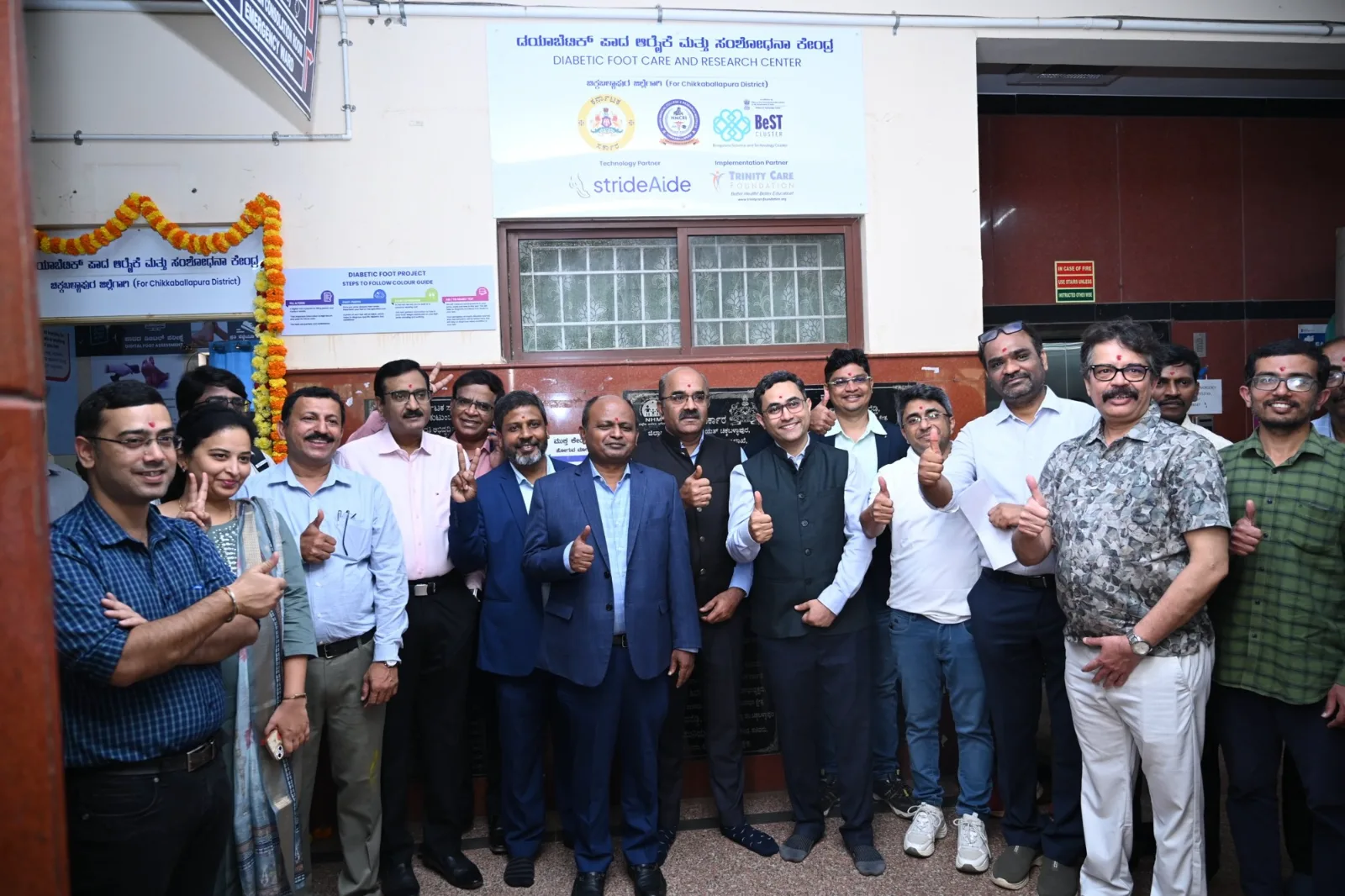
Diabetes damages the feet slowly. Nerves lose feeling, circulation weakens and pressure builds in the wrong places. The result can be ulcers, infections and amputations.
The usual protection is a static custom insole, or an expensive device full of sensors and actuators. Early screening, which could catch the damage in time, is not widely available. StrideAide set out to change both.
Where the engineers met the doctors.
“Most diabetic foot amputations begin with a wound that could have been prevented. We wanted to catch the pressure, and the problem, before the wound.”
StrideAide began as a collaboration between IISc scientists, led by mechanical engineering professor G.K. Ananthasuresh, and doctors at the Karnataka Institute of Endocrinology and Research (KIER), led by Dr. Pavan Belehalli of KIER’s Department of Podiatry. They were looking for ways to protect people with diabetic foot wounds and neuropathy. Prof. Ananthasuresh is now an advisor to the company, which is incubated at IISc, Bengaluru.
Their first idea was an insole that relieves pressure through its mechanical design alone, using compliant mechanisms, with no sensors and no actuators. After strong field results, the team patented it and decided to add AI for everyday foot care. Dr. Sanjay Sharma, a podiatric surgeon and wound-care specialist, and Manoj Kumar R, a product development engineer, joined as co-founders.



A podiatry centre in one unit.
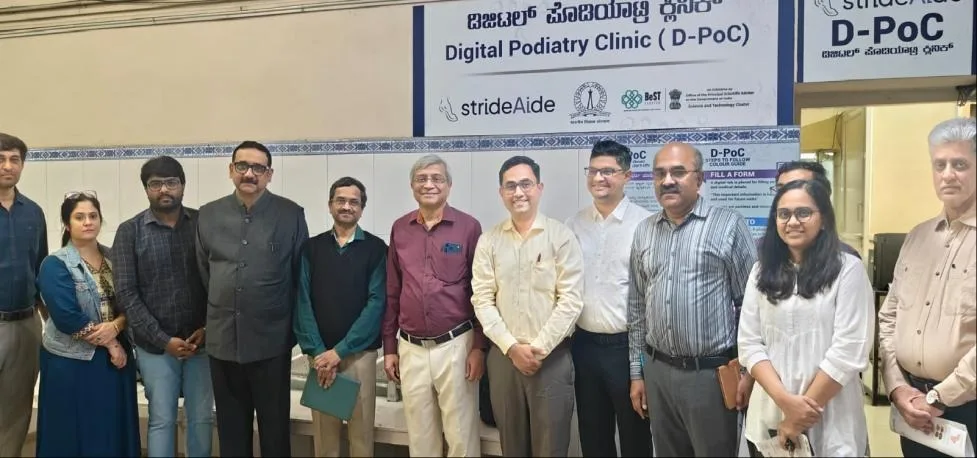
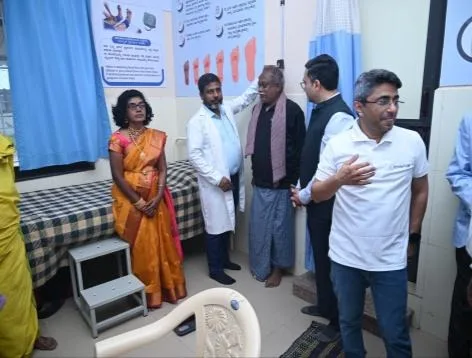
To make screening cheap and widely available, the team built the Digital Podiatry Centre, or D-PoC. It brings together devices that measure plantar pressure, nerve function and blood flow in the foot. StrideAide’s software then uses AI to sort patients by risk and produce automated reports.
In December 2025, StrideAide opened its first D-PoC at the IISc Health Centre. Seven centres are now live across Karnataka and Punjab, including IISc, Chikkaballapur District Hospital, KIER Bengaluru and Nano Hospital, Bengaluru. Each unit can screen 30 to 40 patients a day, BioSpectrum reported, and could screen more than 10,000 people with diabetes a year at a district hospital.
Taking screening to the districts.
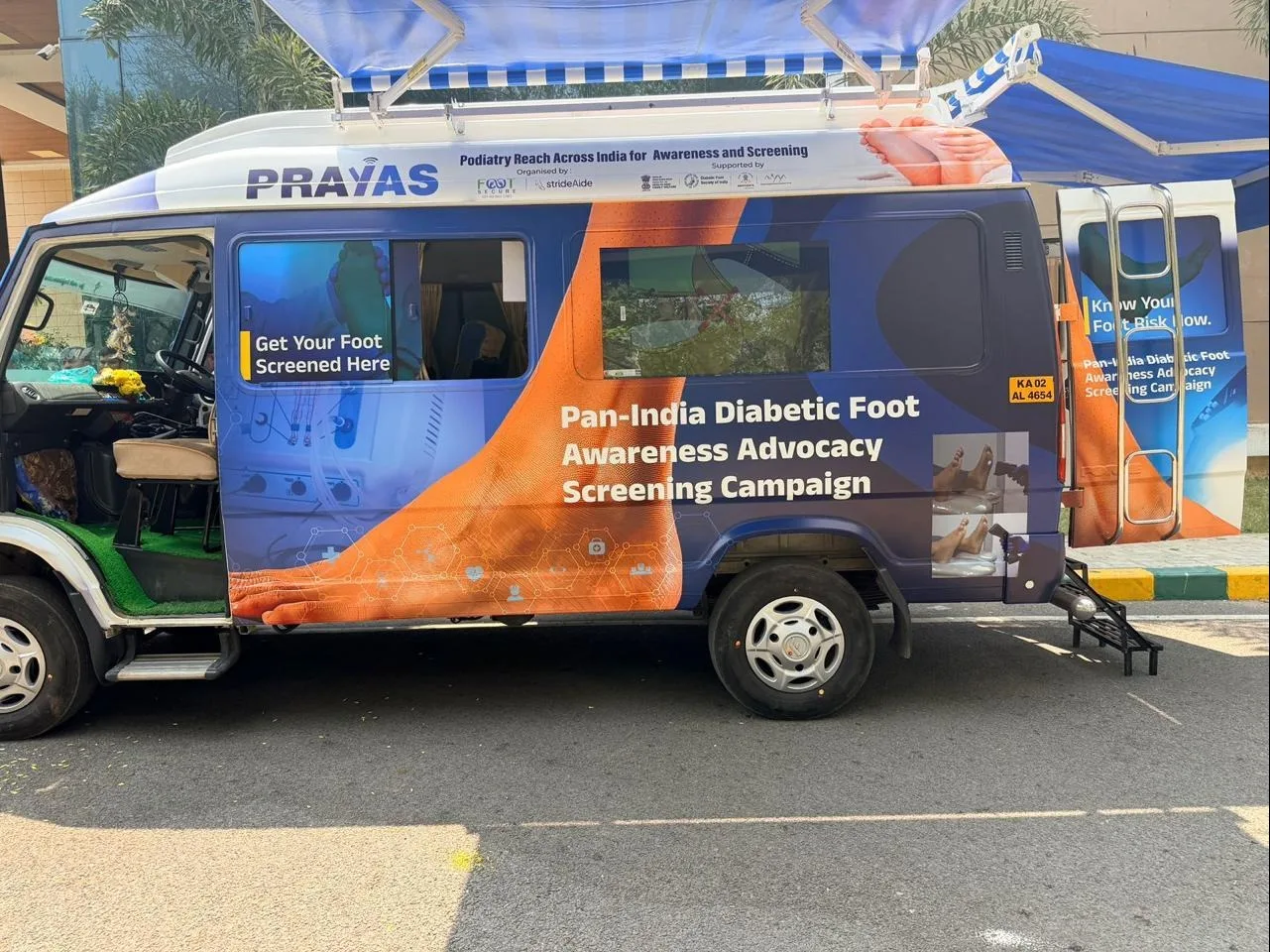
Many people with diabetes never reach a specialist clinic. StrideAide’s community programme, PRAIAS (Podiatry Reach Across India for Awareness and Screening), takes foot screening to them in a mobile van. Across its D-PoC centres and PRAIAS camps, StrideAide has now screened more than 3,500 patients.
Therapeutic footwear that shifts pressure mechanically, with no sensors or actuators, developed with IISc and KIER.
A screening unit for neuropathy, vasculopathy and arthropathy, with AI risk stratification and automated reports. Live at seven centres across Karnataka and Punjab.
In development: a digital twin of the foot, using physics-informed AI.
Implemented: an AI assistant that answers questions from clinicians and patients.
Mobile community screening for diabetic foot disease, across Karnataka districts.
Towards no amputations.
StrideAide has also received grant support from BIRAC and a BIG grant. It is part of ARTPARK’s startup portfolio. The team’s stated aim is an India free of diabetic foot amputations.
- StrideAide, About us (founders, advisors, backers). strideaide.com
- BeST Cluster, “StrideAide startup story” (14 January 2024). linkedin.com
- BioSpectrum, “StrideAide inaugurates Digital Podiatry Clinic at IISc” (17 December 2025). biospectrumindia.com
- ASME IDETC-CIE 2023 paper on compliant footwear. asmedigitalcollection.asme.org
- StrideAide on LinkedIn. linkedin.com
- ARTPARK, startup portfolio. artpark.in
- Founder review and updated story, November 2026