
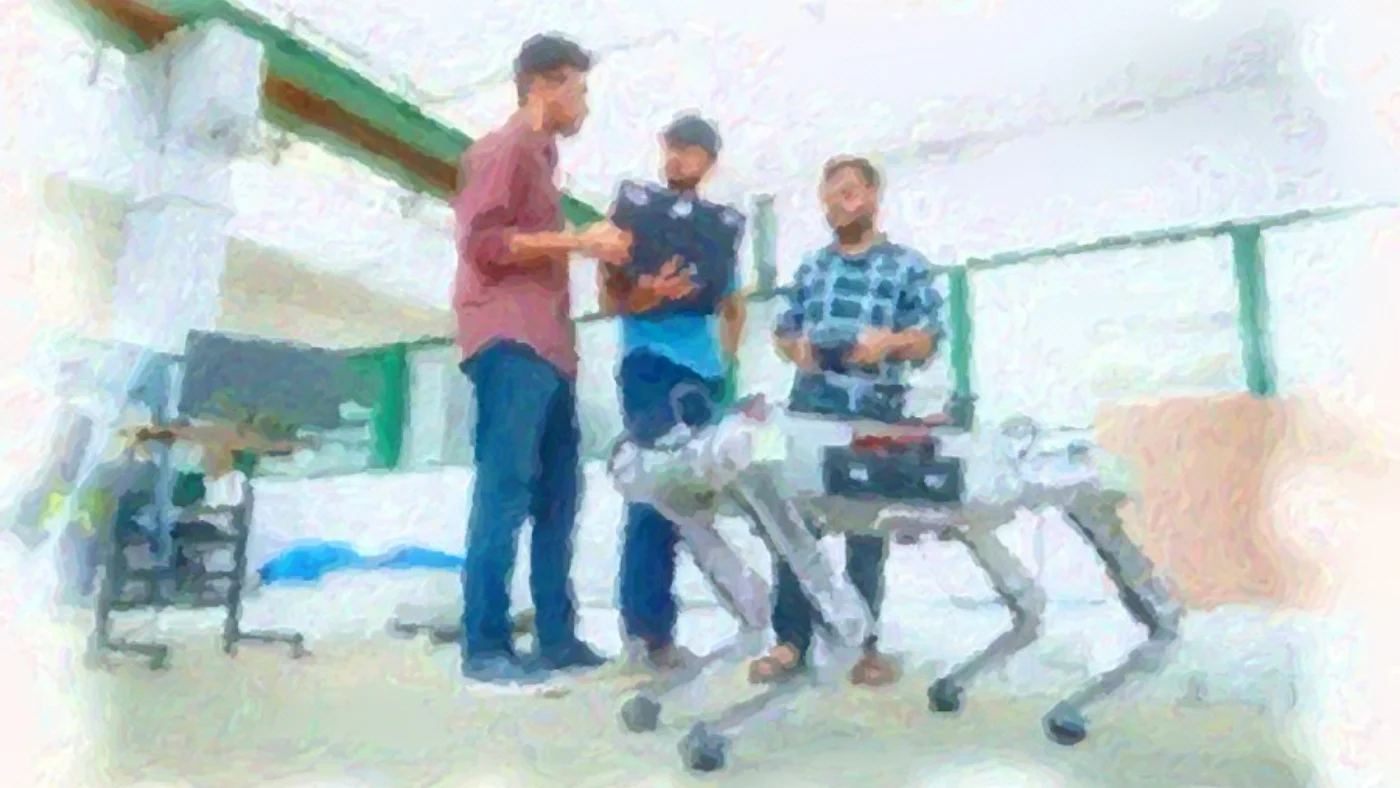
Most robot arms bend at several joints, like a human arm. Omi-1 is built differently: a Cartesian robot that moves up and down, and reaches in and out, along straight axes mounted on a mobile base.
Ometaura AI is in ARTPARK’s Technology Innovator in Residence (TIR) programme, 2026 cohort.
Why straight lines.
2,200 mm.
A telescoping arm that reaches from 200 to 800 mm.
A 360° lidar and an RGB-D depth camera, on a mobile robot base.
The company argues that the Cartesian design pays off in four ways. The control maths is simple and has no singularities, the awkward positions where a jointed arm loses control. A warehouse technician can repair it in hours rather than days. With three axes instead of eight joints, there are far fewer manufacturing tolerances to stack up, which the team says makes assembly about ten times simpler. And fewer parts should mean the robot is available for work more of the time.
Three robots before this one.
Abhishek Gupta was co-founder and CEO of Open Droids, which built three robots under Abhishek: R1D3, a single-arm mobile manipulator; R2D3, a dual-arm mobile manipulator; and Droid 1, a healthcare robot.
Abhishek exhibited at CES 2025 in Las Vegas and at IFA Berlin, and spoke at the AI for Good summit of the UN’s International Telecommunication Union in Geneva.
- ARTPARK Technology Innovators in Residence, 2026 cohort presentations
- Ometaura AI. ometaura.ai