
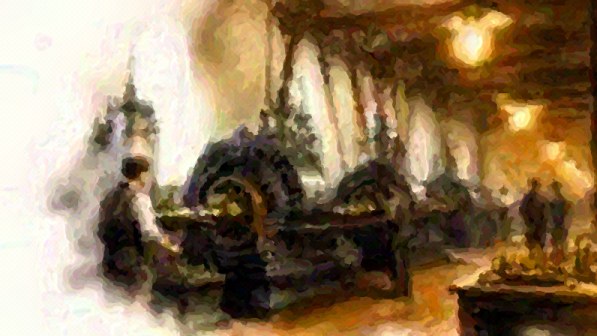
On the afternoon of 4 September 1882, Thomas Edison stood in the Wall Street office of J. Pierpont Morgan, one of his principal backers, and gave a signal. A few blocks away, at 257 Pearl Street, the chief electrician John W. Lieb closed a switch. Roughly 400 lamps came on for some 85 customers in a quarter of a square mile of lower Manhattan.
The next day the New York Times — itself one of the first customers — reported the event under “Miscellaneous City News.”
It is tempting to read that as a failure of imagination. It is more useful to read it as an accurate description. By September 1882, a practical incandescent lamp was not news. Edison's laboratory had demonstrated one almost three years earlier, and lamps made by Joseph Swan were already lighting rooms in England. What was new at Pearl Street was not the lamp. It was everything the lamp needed in order to matter.
This is a story about that everything — and about why the most famous invention in the history of technology is better understood as the first visible part of a system.
A crowded race.
Electric light did not begin with Edison. Humphry Davy demonstrated an electric arc early in the nineteenth century, and by the 1870s arc lamps — two carbon rods with a blazing gap between them — were lighting streets, factories and large halls on both sides of the Atlantic. They were also far too harsh, hot and high-maintenance for a living room. People working in the field understood that indoor lighting would need incandescence: a thin conductor heated until it glows.
The principle had been known for decades. The difficulty was that glowing filaments burned out, fast. Keeping oxygen away from them required a good vacuum, and good vacuums became practical only after Hermann Sprengel's mercury pump of 1865. In Newcastle, the chemist Joseph Swan had experimented with carbon filaments since the 1850s. With better pumps, he demonstrated working carbon lamps in 1878 and 1879; his lamps went on to light Lord Armstrong's house at Cragside and, in 1881, London's Savoy Theatre.
Edison turned to the problem in mid-1878. The IEEE's history of Pearl Street calls him “a relative late-comer” — many others had already contributed dynamos, voltage regulation and lamp designs. What distinguished Menlo Park was less a single idea than an organisation: a well-equipped laboratory with machinists, glassblowers and chemists, and a team that included Charles Batchelor, who led much of the experimental work; the machinist John Kruesi; and Francis Upton, a mathematically trained physicist whose calculations underpinned the system's design. Lewis Latimer, who had patented an improved process for making carbon filaments while at Hiram Maxim's rival company, joined the Edison organisation in 1884.
In Britain, the rivalry between Swan's and Edison's patents ended not in court but in a merger: in 1883 their interests combined as the Edison & Swan United Electric Light Company. The lamp, in other words, had more than one parent. What was much harder to find was anyone who had worked out how to make electric light a business.
Designing the lamp backwards.
Edison's frame of reference was gas. By the late 1870s gas lighting was a mature system: central works, pipes under the streets, meters in buildings, a fitting in each room and a bill at the end of the month. Electricity would have to beat that system on cost and convenience — not merely produce light.
That framing changed the lamp itself. Arc lamps were usually wired in series: one circuit, one current, and when a lamp failed the whole string could go dark. Homes and offices needed lamps that could be switched on and off independently, which meant a parallel circuit, with every lamp connected across the same voltage.
Parallel circuits created a cost problem. Every lamp draws current from the mains, and the more current a network carries, the thicker — and costlier — its copper conductors must be. The way out was to make each lamp draw less current at the chosen voltage, which meant giving the filament a high electrical resistance. The historian Thomas P. Hughes, in Networks of Power, showed that Edison and Upton reasoned along exactly these lines: the economics of copper shaped the filament.
The economics of the copper network set the specification for the filament. The invention was shaped by the system it would live in.
That is why the long search for a filament — the trials of many hundreds of materials — was not simply a search for something that glowed. It was a search for something that glowed with high resistance, lasted long enough and could be made consistently. In October 1879 a carbonised filament at Menlo Park met the first two conditions well enough to be called practical. Meeting the third took years of manufacturing work, including a move to carbonised bamboo in 1880 and later process improvements by Latimer and others.
Everything else that had to exist.
The IEEE's milestone history lists what Edison and his associates had to develop or adapt to deliver light to a single paying customer: a parallel circuit for the high-resistance lamp, an improved constant-voltage dynamo, junction boxes and an underground conduit system, safety fuses and insulating materials, a consumption meter, light fixtures and switches. Then they set up companies to manufacture most of it.
Six steam-driven “Jumbo” dynamos, adapted from a Siemens design.
About 80,000 ft of insulated copper conductors under the streets.
Fuses and insulation, so a fault in one building did not become a fire.
A meter, so electricity could be sold the way gas was.
Companies to make lamps, dynamos, conductors and fittings.
A city franchise to dig, and investors willing to wait.
Generation was its own engineering project. The station's “Jumbo” dynamos — named after P.T. Barnum's famous elephant and weighing about 27 tons each — were adapted from an earlier design by Werner Siemens. Six were installed, each rated at roughly 100 kilowatts and able to supply about 1,200 lamps, driven by Armington & Sims steam engines fed from four coal-fired boilers.
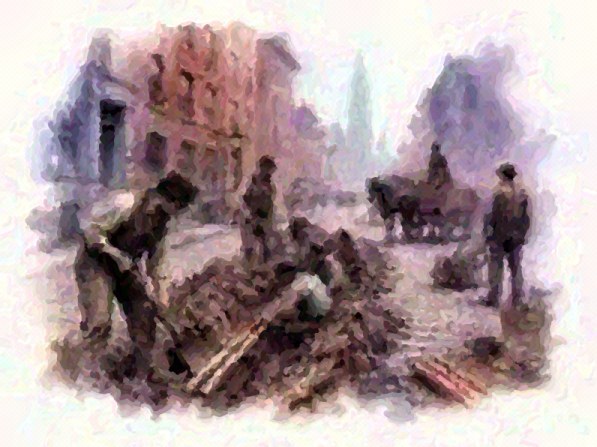
Distribution was harder, and more expensive. About 80,000 feet of underground conductors were laid through the First District: paired, half-moon-shaped copper conductors in conduit, separated by rope and insulated with a mixture of beeswax, linseed oil and asphaltum. According to the IEEE history, the main and feeder network was the single most expensive component of the project.
Some problems could not be solved in a laboratory at all. To dig up public streets, the newly formed Edison Electric Illuminating Company of New York needed a franchise from the city's Board of Aldermen, granted in April 1881. The service area was chosen deliberately, after what amounted to market research: a dense, mixed district bounded by Wall Street, Nassau Street, Spruce Street and the East River — home to the country's financiers and to the city's influential newspapers. These were exactly the customers and observers whose confidence the project needed.
Even billing was an invention problem. Edison's early meter was electrochemical: current passing through a cell deposited metal on a plate, and the plate was weighed to work out how much electricity a customer had used.
Rehearsals.
Pearl Street was not Edison's first installation. In January 1881 the company lit the New York printing firm of Hinds, Ketcham & Company from a dynamo in its own basement — an “isolated plant” serving one customer. Isolated plants became a significant business in their own right: factories, hotels, ships and wealthy households bought self-contained systems long before central stations reached them.
In London, a central station under the Holborn Viaduct began operating in January 1882 and ran for about two years, showing that the central-station idea could work technically. Pearl Street was meant to prove something harder: that a permanent station in a dense city could be built, run reliably and, eventually, pay for itself.
What Pearl Street proved — and what it didn't.
On reliability, the record is remarkable. The station delivered power from September 1882 to January 1890 with, according to the IEEE history, only one interruption, lasting three hours. When a fire badly damaged it on 2 January 1890, crews restored service within 11 days.
On economics, the picture is more mixed. The six dynamos could supply about 7,200 lamps; on the first day, around 400 were connected. Demand grew quickly — to about 10,000 lamps and 513 customers within a year — but the IEEE history is plain that Pearl Street “was not an immediate financial success.” Its value lay in demonstration. It convinced customers, investors and other cities that the system worked, and Edison-style stations were soon licensed across North America, Europe, South America and Japan.
The copper problem never went away. Edison soon replaced the original two-wire, 110-volt arrangement with a three-wire, 220-volt design that greatly reduced the copper required. John Hopkinson arrived at the same idea independently in Britain at about the same time. It was elegant engineering, and a reminder that some of the most important inventions in the system were about cost, not light.
Some of the most important inventions in the system were about cost, not light.
Even so, low-voltage direct current had a hard limit. Losses rose steeply with distance, so each station could economically serve only a small, dense area. By the mid-1880s, alternating-current systems — built on work by Lucien Gaulard and John Gibbs, William Stanley, Nikola Tesla, Elihu Thomson, Mikhail Dolivo-Dobrovolsky and others, and promoted by industrialists such as George Westinghouse — were using transformers to send power over long distances at high voltage. Pearl Street was retired in 1895. The central-station model it pioneered survived; many of its particular technical choices did not.
What the story teaches.
The light bulb is usually offered as the emblem of a lone inventor's flash of insight. The record suggests nearly the opposite. The lamp drew on decades of other people's work. It was refined by a team. Its specification was set by the economics of a distribution network. And its impact depended on generators, conductors, meters, fuses, factories, permits, capital and customers — many of which had to be invented or adapted for the purpose.
None of that diminishes the lamp. It locates it. The distance between a working invention and a working system is not filled by paperwork. It is filled by more invention, of a less celebrated kind.
Deeptech teams meet versions of the same problem today. A robot that performs in a lab demonstration still needs power, maintenance, a safety case, integration with the systems around it and a unit cost a customer can bear. A sensor that works on a bench must survive heat, dust and vibration, and be made in thousands. Often the question that decides a technology's future is the equivalent of Edison's copper bill: a cost or constraint sitting outside the core invention, invisible until someone tries to build the whole system.
That is the work ARTPARK is organised around — not replacing the breakthrough, but helping teams build what the breakthrough needs.
A breakthrough can work in isolation and still be far from a useful, scalable solution.
- Carl Sulzberger, “Milestones: Pearl Street Station, 1882,” IEEE / Engineering and Technology History Wiki. Primary source for station figures, dates and attribution in this article.
- Thomas P. Hughes, Networks of Power: Electrification in Western Society, 1880–1930 (Johns Hopkins University Press, 1983).
- Robert Friedel and Paul Israel, Edison's Electric Light: The Art of Invention (Johns Hopkins University Press, revised edition 2010).
- The Thomas A. Edison Papers, Rutgers University — laboratory notebooks and correspondence.
- Smithsonian National Museum of American History, “Lighting a Revolution.”
Where accounts differ — on customer counts, lamp lifetimes and exact dates — we follow the IEEE milestone record and mark figures as approximate. ARTPARK had no involvement in the history described here.