Every major public health challenge leaves traces before it becomes visible in a hospital, a laboratory, or a surveillance report. Those traces often exist in the environment: in weather patterns, changing ecosystems, vector habitats, water systems, and the movement of pathogens through human and animal populations.
We miss many of these signals not because they are invisible, but because our health systems were not designed to see them.
ARTPARK is building systems that do.
World Environment Day 2026 asks us to be inspired by nature, for climate, for our future. For those working at the intersection of climate and public health, that is more than a them— it is a design principle!
Healthy ecosystems are not separate from public health systems. They influence where vectors thrive, how heat accumulates in cities, how diseases spread, and how communities experience climate risks. Understanding these environmental signals is increasingly essential to protecting human health.
What the environment carries before symptoms appear
Make it stand out
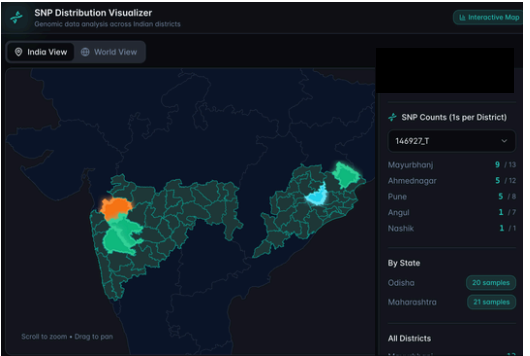
Many emerging infectious diseases move through interconnected human, animal, and environmental systems long before they appear in clinical surveillance. Pathogens can circulate through ecosystems, water, soil, and air, creating signals that often remain invisible to conventional disease surveillance systems.
Dharini, ARTPARK's environmental surveillance platform, is built on a different premise. It operates within the One Health framework, which recognises human, animal, and environmental health as deeply interconnected. By strengthening surveillance through environmental samples such as water, soil, and air, Dharini seeks to support the earlier identification of potential health threats.
The implications extend into food security and rural livelihoods. India's livestock sector contributes 4.9% to national GDP and is the primary economic base for millions of small and marginal farmers. Diseases like Foot-and-Mouth Disease, Lumpy Skin Disease, and Avian Influenza are not contained animal health problems. They are livelihood risks, trade risks, and potential spill over risks.
Dharini, alongside ARTPARK's broader livestock disease surveillance work, is designed to strengthen the early detection of these threats and support more proactive responses.
Dengue is shaped by environmental signals
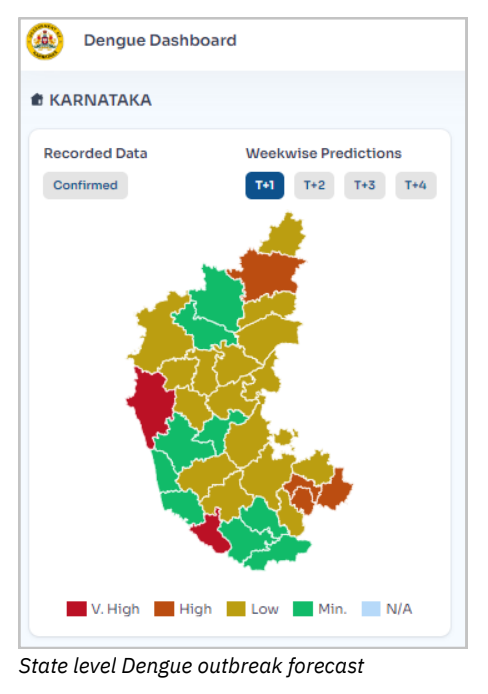
Dengue is not driven by human health factors alone. The disease is closely linked to environmental conditions that influence the behaviour and distribution of its vector. Rainfall creates breeding habitats, temperature affects mosquito survival and transmission dynamics, and local environmental conditions shape disease risk across communities.
These signals exist long before they become visible in disease surveillance data. Understanding them is critical for anticipating risk and supporting timely public health action.
ARTPARK’s Dengue work through its PRISM-H, Platform for Research Integrated Surveillance and Management of Health, was built to bring these signals together. The platform integrates epidemiological trends with weather and environmental data to generate dengue-risk forecasts at the sub-district level, up to two weeks in advance.
The initiative is helping Karnataka supporting over 70 million people. In its pilot, it supported mosquito larval survey by surveying over 1.2 million houses, and the identification of more than 50,000 breeding spots. It was recognised in the UN World Cities Report 2024 and received the SKOCH Award for E-Governance in 2025.
The rainfall data was there. The temperature patterns were there. The science of vector ecology was already understood. What was missing was the infrastructure to bring these signals together at the resolution and scale required for public health decision-making.
Heat is more than a weather event
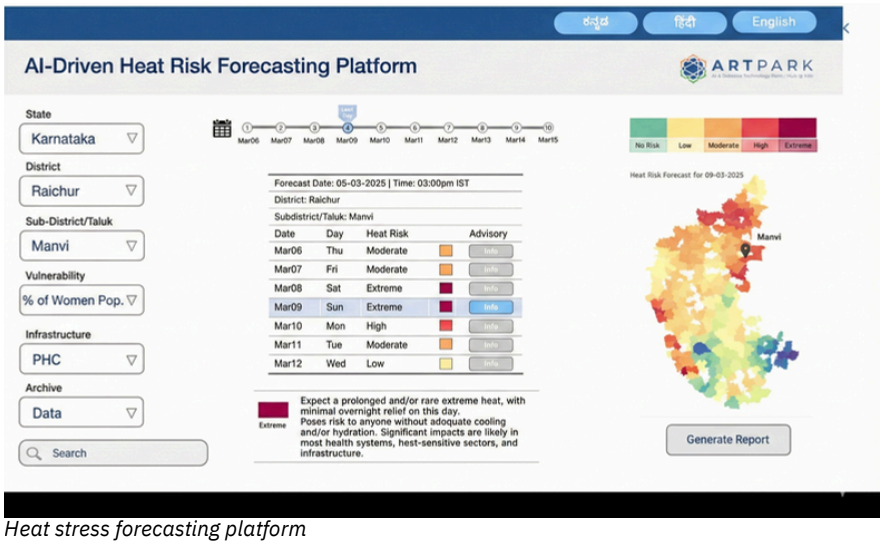
Across India, heat events are becoming more frequent and more intense. They affect physical and mental well-being, strain livelihoods for outdoor workers and farming communities, and create significant health risks across vulnerable populations.
Environmental conditions influence how heat is experienced by the human body, placing additional physiological stress on vulnerable populations and worsening outcomes for people with pre-existing health conditions.
ARTPARK's heat-risk forecasting platform delivers localised heat-risk predictions at sub-district resolution, up to seven days ahead. It goes beyond temperature by integrating biometeorological heat stress indicators, and physiological thresholds to produce impact-based forecasts – a comprehensive understanding of heat-related risk.
The platform is being developed and deployed in collaboration with the Government of Karnataka, including KSNDMC, KSDMA, and the Department of Health. It is the winner of Grand Challenges India and winner-finalist of IndiaAI Innovation Challenge 2025.
Understanding heat as a health risk requires bringing together insights from climate science, biometeorology, and public health. The challenge is not only generating these insights, but translating them into information that can support action on the ground.
Three platforms. One underlying logic.
Dharini, PRISM-H, and the heat platform are distinct systems addressing distinct threats. The logic connecting them is the same.
Climate and health interact constantly. Dengue is climate-sensitive. Heat stress worsens health outcomes. Livestock diseases affect food security and create spillover pathways into human populations. These risks share geography, affect the same vulnerable populations, and compound each other in ways that siloed surveillance systems are structurally unable to see.
ARTPARK's work treats this as a single interconnected system and builds accordingly, across data, models, and delivery, in partnership with research institutions, government, and the private sector.
COVID-19 demonstrated what functional data systems make possible in a public health emergency. Climate change is reshaping India's epidemiological landscape now, in vector habitats, in the physiology of heat-stressed populations, in the movement of pathogens through shared ecosystems. The signals are already present in the environment. Building infrastructure that reads them, at speed and at scale, is the work.
On this World Environment Day, the lesson is simple: protecting human health increasingly requires understanding and responding to the health of the environments around us. Building systems that connect those realities, and translate environmental signals into timely action, is the work ARTPARK is pursuing
ARTPARK partners with governments, research institutions, and the private sector on surveillance and predictive systems for climate and public health. If you are working on related problems, we would like to hear from you.